 Live · Daily New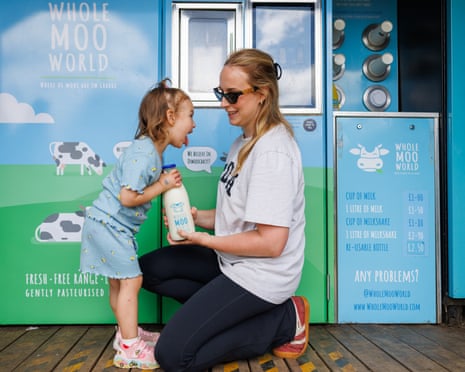
Fizzy drinks, packets of crisps and bars of chocolate: for decades, vending machines were known as a place to grab a quick snack. Now one family of farmers is trying to change that by bringing vending machines offering fresh milk and local produce – including scotch eggs, sausage rolls and brownies – to villages and other rural locations. Mark James, 70, and his sons Sam, 39, and Jacob, 36, first trialled vending machines as a way of selling their milk directly to consumers, giving themselves more control over the price they receive.
“For the first time ever, we’re price makers rather than price takers,” Mark says. “If we weren’t doing [the vending machine business], we’d have to think about giving up milk.” Just under a third (30%) of the 4,500 litres of milk produced each day by the family’s herd of 130 dairy cows at Bodenham in Herefordshire is sold at their 17 Whole Moo World vending machines, located across Herefordshire and the neighbouring counties of Gloucestershire , Worcestershire and Shropshire. The remaining 70% is sold to a local milk processor.
Mark James (right) and his son Sam at the Whole Moo World and Tuckshop vending machines at the Primrose Vale pick-your-own and farm shop near Cheltenham. Photograph: Sam Frost/The Guardian When Whole Moo World took off, Jacob and Sam branched out into retailing cakes, sandwiches and other treats made by small local producers from vending machines. Their business, Tuckshop, now has 22 sites, mostly alongside the milk machines, and also allows them to sell empty glass bottles for milk.
Jacob says farmers are “waking up” to the advantages of selling directly to consumers, even if they do not have a suitable location or the funds needed to build their own farm shop. Jacob James believes farmers are ‘waking up’ to the advantages of selling directly to consumers. He believes vending machines could be the answer for villages and small rural communities at risk of becoming “food deserts” , where lower-income households struggle to find fresh healthy food amid closures of local shops and poor public transport.
They also promise a more profitable way for squeezed farmers to reach customers directly and avoid expensive fees for intermediaries. Dairy producers in Britain and beyond have suffered in recent years from a boom and bust price cycle , where the price of milk, a globally traded commodity, has been extremely volatile. Strong global demand for dairy has usually led to farmers increasing their herd size and upping production, followed by oversupply and a crash in the milk price.
Farmgate milk prices began to tumble again earlier this year, Mark says. “In August last year we were paid 44p a litre, and ever since the beginning of February it’s been down at 30p a litre.” For many dairy farmers, including the Jameses, this price does not cover the cost of production. Margins in the industry have always been tight and UK supermarkets have traditionally used low milk prices to tempt shoppers through the door, and the milk processing sector is dominated by three main players – Arla, Müller and First Milk .
British supermarkets are currently charging between £1.20 and £1.30 for a two-pint, or 1.1-litre, bottle of milk. Whole Moo World customers pay £1.50 for a litre of the family’s unhomogenised milk – where the cream has not been separated from the milk during processing – delivered into a refillable glass bottle, which customers can buy once in the vending machines and wash and reuse. A litre of milkshake – with flavours including chocolate, strawberry, banana and specials such as mint choc and blueberry muffin – costs £2.90.
Moo World customers pay £1.50 for a litre of the family’s unhomogenised milk in a glass bottle. Photograph: Sam Frost/The Guardian Mark James says customers are prepared to pay a small premium for milk that, he says, tastes creamier and is more environmentally friendly thanks to the use of glass bottles. This is the Jameses’ second stint as dairy farmers.
Mark took over his parents’ farm but quit milk production during the 2015 crisis , when low wholesale prices made it impossible to remain profitable. The family subsequently diversified their business, farming beef cattle and opening holiday lets, but the rolling banks of their land did not make it particularly suited to growing arable crops. The younger generation of the James family only supported a return to milk production if they ran the business differently.
“It is only through doing this [the vending machines] that I have any interest in being a dairy farmer,” Sam says. It is not just the machines that make a difference: the mixed herd of dairy cows are milked by robots at a time of each cow’s choosing, freeing the family from 4am alarms and the labour-intensive nature of traditional milk production. Vending machines sell brownies, banoffee pie, cakes, sandwiches and other treats made by small local producers.
Photograph: Sam Frost/The Guardian On the day the Guardian visited one vending machine located next to the Primrose Vale pick-your-own and farm shop on the outskirts of Cheltenham, there was a steady flow of customers who arrived to fill up their glass bottles from the machines. “Our big issue is how to break the habit of [customers] picking milk up in a supermarket, and that is the difficulty because this means that someone is going to make a special trip to come here,” Mark says. For this, finding the right location is vital.
Placing the vending machines next to a farm shop has mutual benefits for both businesses, says Jon Henley, one of the managers at Primrose Vale. “The machines seem to be bringing customers in 24/7, and then they see our strawberries and come back for the pick-your-own or the charging points [for electric vehicles]. It can also be helpful in winter when there isn’t much seasonal picking.” The machines are also a novelty for children.
“We come to pick berries and then get milk. The machine is fun for little ones,” says Emma Coulter, buying a bottle of milk with help from her three-year-old daughter, Bonnie. Sam Carter-Campbell, who admits to treating himself to a strawberry milkshake as he drives around Gloucestershire for his job as an electrician, says: “I feel like I’m their best customer as I’m at the machine every day.
I occasionally have a brownie, too, but sometimes I look and think, ‘I’d better not.’” Sam Carter-Campbell, an electrician, says he visits the Whole Moo World vending machine every day. Photograph: Sam Frost/The Guardian One customer, who gave her name as Vicky, describes the machines as a good idea, provided they are installed in the right places in pretty villages and do not become an “eyesore”. The technology that powers vending machines has made significant advances in recent years, according to David Llewellyn, the chief executive of the Vending and Automated Retail Association.
“It’s no longer just a standalone mechanical machine, which you don’t have any control over. Now with cashless payments, telemetry and connected equipment, you can see what’s happening, what needs replenishing and it will maintain a range of different temperatures,” he says. Machines stocked with fresh local produce have been available for consumers in France and Italy for some time, adds Llewellyn, while there is one machine for every 35 people in Japan.
That compares with one for every 169 in the UK, where most are coffee and hot beverage outlets, usually found in factories and other workplaces. Although the James family can now monitor their machines remotely, they still refill them with milk themselves, travelling to locations within a 30-mile radius of their farm. They plan to keep expanding and may have to take on staff to support the business.
“There is a new site we are looking at at the moment, a village of a couple of thousand people, where we think we could provide basic food like milk, eggs, cheese and sandwiches,” Jacob says. “We can do that fairly quickly. The place would support a a farm shop, but vending is much cheaper to install and run.”
Source: The Guardian